Why the Choice Matters More Than Most People Realise
When a tooth is lost — whether from decay, gum disease, infection or trauma — two questions tend to dominate: how quickly can it be replaced, and how much will it cost? These are fair questions, but they are not the most important ones.
The most important question is: which replacement option protects the rest of your mouth over the next 10, 20, or 30 years? The answer to that determines whether you make one trip to the dentist to solve the problem permanently, or find yourself back in the chair every decade replacing failing restorations and managing progressive bone loss.
This article lays out the full, evidence-based comparison — survival rates, bone preservation, adjacent tooth health, cost over time, and candidacy — so you can have an informed conversation with Dr. Mahaprasad about what is right for your specific situation.
Quick Insight — The Numbers
A 2019 systematic review and sensitivity meta-analysis of 18 studies found dental implants have a 10-year survival rate of 96.4%. A parallel systematic review of fixed dental bridges found a 15-year survival rate of 70–85% — with most bridges eventually requiring replacement within 10–15 years. These numbers frame the entire comparison that follows.
What Is a Dental Implant?
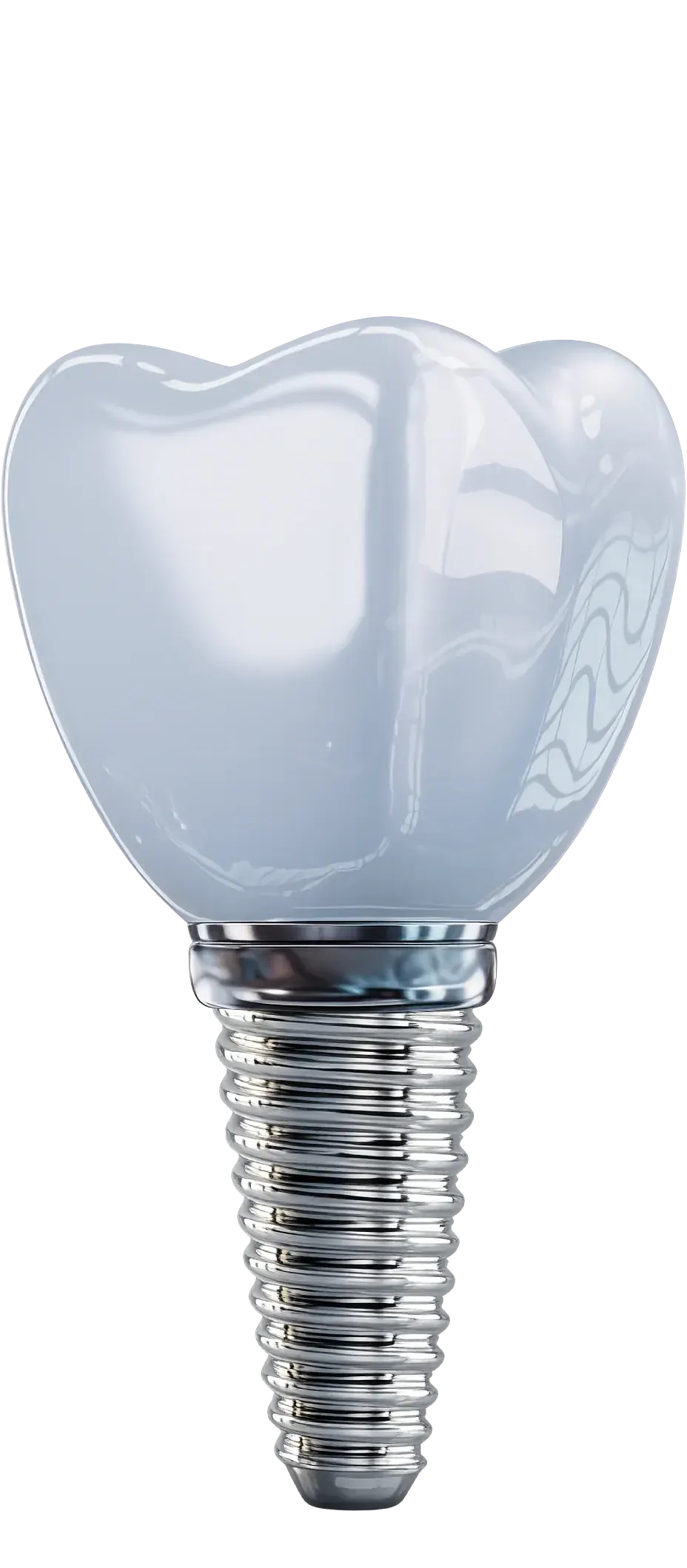
A dental implant is a three-part restoration: a titanium post that is surgically placed into the jawbone (acting as an artificial root), an abutment connector, and a custom-made ceramic crown on top. The titanium post fuses with the surrounding bone through a process called osseointegration — typically taking 2–4 months — after which the implant behaves mechanically like a natural tooth root.
Crucially, the implant is a standalone replacement: it does not involve or rely on the teeth on either side of the gap.
How the Procedure Works
- Consultation & X-ray / 3D scan: bone quantity and quality assessed; treatment planned
- Implant placement: titanium post placed surgically under local anaesthesia — single appointment
- Osseointegration: 2–4 months for bone to fuse with the post
- Crown placement: custom ceramic crown fitted over the abutment
- Total treatment time: 3–6 months typically
What Is a Dental Bridge?
A dental bridge is a fixed prosthesis that spans a gap by anchoring onto the two natural teeth on either side — called abutment teeth. Those abutment teeth must be permanently ground down by 60–70% of their structure so that crowns can be cemented over them to support the artificial tooth (called a pontic) suspended in the middle.
The result looks like three crowns joined together — one on each abutment tooth, one in the middle replacing the missing tooth. A bridge can be completed in 2–3 clinic visits over 2–3 weeks, with no surgery required.
Head-to-Head Comparison
| Factor | Dental Implant | Dental Bridge |
|---|---|---|
| Survival at 10 years | 96.4% (systematic review, 2019) | ~80–87% (varies by location) |
| Survival at 15 years | ~90–94% | 70–85% |
| Surgery required? | Yes — minor outpatient procedure | No |
| Treatment time | 3–6 months (includes healing) | 2–3 weeks |
| Adjacent teeth affected? | No — standalone | Yes — ground down permanently |
| Bone preservation | Yes — stimulates jawbone like a root | No — bone loss continues in gap |
| Cleaning | Brush and floss normally | Requires floss threader under bridge |
| Upfront cost | Higher | Lower |
| Long-term cost | Lower (rarely needs replacement) | Higher (bridge may need replacement 1–2×) |
| Feel and function | Closest to natural tooth | Very good, but not root-supported |
| Reversibility | Not reversible (but permanent) | Not reversible (abutment teeth altered) |
| Best suited for | Most single or multiple tooth gaps; long-term thinkers | Patients avoiding surgery; faster timeline; budget constraints |
The Bone Loss Factor — The Detail Most Clinics Don't Explain
When a tooth is extracted, the jawbone in that area immediately begins to resorb — because there is no longer a root to stimulate it. Research shows that within the first year after tooth loss, the width of the jawbone in the extraction site can reduce by 25% or more, with significant vertical bone loss continuing over the following years.
A dental bridge replaces the visible crown of the tooth — but the gap in the bone below remains. Over years and decades, this progressive bone loss can change the shape of the face subtly, make future dental work more complicated, and cause the gum tissue under the bridge to recede, creating an aesthetic gap under the pontic that is difficult to correct.
A dental implant, by contrast, places a titanium post in the bone. Through osseointegration, the bone fuses with and surrounds this post — halting bone loss and preserving the bone volume in a way that no other tooth replacement option achieves.
Why This Matters Long-Term
Patients who lose a tooth in their 30s or 40s and choose a bridge may find, by their 50s or 60s, that the bone loss in that area has progressed to the point where an implant is significantly more difficult or expensive to place — sometimes requiring a bone graft first. Addressing tooth loss early with an implant, while bone is still abundant, is almost always simpler and more cost-effective than waiting.
What the Survival Rate Data Actually Shows
A 2019 systematic review published in the Journal of Dentistry analysed 18 studies and found a 10-year implant survival rate of 96.4% at implant level. A 2024 meta-analysis in Clinical Oral Investigations extended the picture, confirming that well-placed implants continue to function reliably well beyond 20 years in most patients.
For bridges, a systematic review by Pjetursson et al. found 5-year survival rates of around 93%, but at 10 years and beyond the picture changes significantly, with more bridges requiring replacement, recementation, or addressing secondary caries in the abutment teeth beneath the crowns.
Perhaps most clinically significant is a systematic review comparing implant crowns to fixed bridges on economic grounds, which concluded that the value of preserving healthy adjacent teeth makes the implant crown more economically rational for the patient — even when upfront costs are higher — because bridges permanently sacrifice healthy tooth structure that cannot be restored.
Key Takeaways
- Implants have a 10-year survival rate of 96.4% — bridges average 70–85% at 15 years
- A bridge permanently grinds down two healthy neighbouring teeth — implants require zero modification to adjacent teeth
- Bone loss under the gap continues with a bridge; implants prevent it entirely
- Over a lifetime, implants are typically more cost-effective despite higher upfront cost
- Bridges are a clinically valid, excellent option for patients who cannot undergo surgery or need fast treatment
- The sooner a missing tooth is addressed, the better the bone volume and the simpler the treatment
Myths vs Facts
Which Option Is Right for You?
Implant Is Likely the Better Choice If…
- You are in good general health with no major uncontrolled medical conditions
- You have sufficient jawbone volume (or are willing to have a bone graft if needed)
- The adjacent teeth on either side of the gap are healthy — there is no clinical reason to crown them
- You are a non-smoker or light smoker (heavy smoking significantly increases implant failure risk)
- You value a long-term solution over faster, lower-upfront cost
- You want to preserve your jawbone and the shape of your face over decades
A Bridge May Be the Better Choice If…
- You have a medical condition that contraindicates surgery (uncontrolled diabetes, blood thinners, certain bone medications)
- You have severe bone loss at the implant site and do not want a grafting procedure
- You need the tooth replaced urgently within weeks, not months
- The adjacent teeth already need crowns for their own clinical reasons — in that case, a bridge piggybacks on necessary work
- Budget constraints make the lower upfront cost of a bridge the deciding factor at this time
Bone Preserved
Only an implant prevents the bone loss that begins within weeks of a tooth extraction.
Adjacent Teeth Safe
Implants require no modification to neighbouring teeth — they remain fully intact.
Proven Longevity
96.4% survival at 10 years — and many implants remain functional for 20+ years.
Natural Feel
Root-supported, fused to bone — an implant feels and functions closest to your natural tooth.
Implants and Bridges at Sai Dental Studio, Bhubaneswar
At Sai Dental Studio, Patrapada, Bhubaneswar, both implants and bridges are offered as high-quality restorations. Dr. A. Mahaprasad will assess your bone volume using digital X-ray (OPG), review your medical history, examine the adjacent teeth, and give you an honest clinical recommendation — not based on what is quicker to provide, but on what is in your best long-term interest.
Every treatment plan is transparent: you will know exactly what is involved, how many appointments, how long treatment takes, and the cost breakdown, before anything is agreed.
Frequently Asked Questions
For most patients with adequate bone and no major health contraindications, implants are considered the superior long-term option. They preserve jawbone, do not require grinding down adjacent teeth, and have a 10-year survival rate of 96.4% vs 70–85% for bridges. However, bridges remain an excellent, valid option for patients who cannot have surgery or need a faster, lower-upfront-cost solution.
Systematic reviews show dental implants have a 10-year survival rate of 96.4% and remain functional well beyond 20 years in many cases. Fixed dental bridges have a 15-year survival rate of around 70–85%, with most requiring replacement at some point within 10–15 years.
Yes — a traditional fixed bridge requires the two teeth on either side of the gap (called abutment teeth) to be permanently ground down by 60–70% so crowns can be placed over them to support the bridge. These healthy teeth are irreversibly altered. Implants require no modification to neighbouring teeth.
Yes. A titanium implant post stimulates the jawbone just like a natural tooth root, preventing the bone resorption that otherwise begins within weeks of a tooth being lost. A bridge replaces the visible crown but leaves the gap in the jawbone unfilled, so bone loss in that area continues over time.
Implant costs vary based on the number of implants, the type of crown, and bone condition. Contact Sai Dental Studio at +91 74378 99999 for a personalised treatment plan and transparent cost estimate. A bridge is typically lower in upfront cost but may need replacement 1–2 times in a lifetime.
Patients with uncontrolled diabetes, active gum disease, insufficient jawbone (without a bone graft), those on certain medications, or patients who smoke heavily may face higher implant failure risk. Children and teenagers whose jaws are still developing are also not suitable candidates. A clinical assessment and X-ray at Sai Dental Studio will determine your suitability.
The implant post is placed surgically in a single appointment. Healing (osseointegration) takes 2–4 months. The final crown is placed after that — so total treatment is typically 3–6 months. A bridge can be completed in 2–3 visits over 2–3 weeks.
Yes, though the longer you wait, the more bone may have been lost, which can require a bone graft procedure before implant placement. It is best to consult a dentist as soon as possible after tooth loss to assess your options while bone volume is still adequate.
Conclusion
For most patients, dental implants represent the gold standard for replacing a missing tooth — preserving bone, protecting adjacent teeth, and outlasting bridges by a significant margin according to the clinical evidence. A 10-year survival rate of 96.4%, combined with the ability to function well into a patient's 20th year and beyond, makes implants the most durable tooth replacement available.
That said, bridges are not a second-rate option. They are a clinically valid, well-established treatment that suits patients who want a faster result, cannot undergo surgery, or face budget constraints. In cases where adjacent teeth already require crowns for their own clinical reasons, a bridge can be a highly rational and efficient solution.
The right answer is the one that fits your bone, your health, your timeline and your goals — not a blanket recommendation. At Sai Dental Studio, Patrapada, Bhubaneswar, Dr. A. Mahaprasad will give you an honest clinical opinion based on your specific situation, along with the information to make the decision confidently.
Based on peer-reviewed dental literature as cited in the references below. Individual outcomes vary — always follow the personalised advice of your treating dentist.
References
- Howe MS, Keys W, Richards D. Long-term (10-year) dental implant survival: A systematic review and sensitivity meta-analysis. J Dent. 2019;84:9–21. DOI: 10.1016/j.jdent.2019.03.008 · ScienceDirect: sciencedirect.com (10-year implant survival systematic review — 96.4% summary estimate — not affiliated with this article)
- Kupka JR, König J, Al-Nawas B, Sagheb K, Schiegnitz E. How far can we go? A 20-year meta-analysis of dental implant survival rates. Clin Oral Investig. 2024;28:541. DOI: 10.1007/s00784-024-05929-3 · Springer: link.springer.com (20-year implant survival meta-analysis — not affiliated with this article)
- Pjetursson BE, Thoma D, Jung R, Zwahlen M, Zembic A. A systematic review of the survival and complication rates of implant-supported fixed dental prostheses (FDPs) after a mean observation period of at least 5 years. Clin Oral Implants Res. 2012;23(Suppl 6):22–38. DOI: 10.1111/j.1600-0501.2012.02546.x · PubMed: PMID 23062116 (Implant-supported FDP survival and complications — not affiliated with this article)
- Pjetursson BE, Tan K, Lang NP, et al. A systematic review of the survival and complication rates of fixed partial dentures (FPDs) after an observation period of at least 5 years. Clin Oral Implants Res. 2004;15(6):625–642. DOI: 10.1111/j.1600-0501.2004.01117.x · PubMed: PMID 15533124 (Fixed dental bridge survival and complications — not affiliated with this article)
- Brägger U, Karoussis I, Persson R, Pjetursson B, Salvi G, Lang N. Implants versus short-span fixed bridges: survival, complications, patients' benefits. A systematic review on economic aspects. Clin Oral Implants Res. 2012;23(Suppl 6):50–62. DOI: 10.1111/j.1600-0501.2012.02543.x · PubMed: PMID 23062127 (Implant crown vs fixed bridge — economic and clinical systematic review — not affiliated with this article)
- Schropp L, Wenzel A, Kostopoulos L, Karring T. Bone healing and soft tissue contour changes following single-tooth extraction: A clinical and radiographic 12-month prospective study. Int J Periodontics Restorative Dent. 2003;23(4):313–323. PubMed: PMID 12956475 (Bone resorption after tooth extraction — not affiliated with this article)
- American Dental Association. Oral Health Topics — Missing Teeth and Tooth Replacement. ada.org — Oral Health Topics (Patient education resource — not affiliated with this article)
- World Health Organization. Oral Health Fact Sheet. who.int — Oral Health (General public health reference — not affiliated with this article)
- National Library of Medicine — PubMed. pubmed.ncbi.nlm.nih.gov (Database used for peer-reviewed dental research — not affiliated with this article)